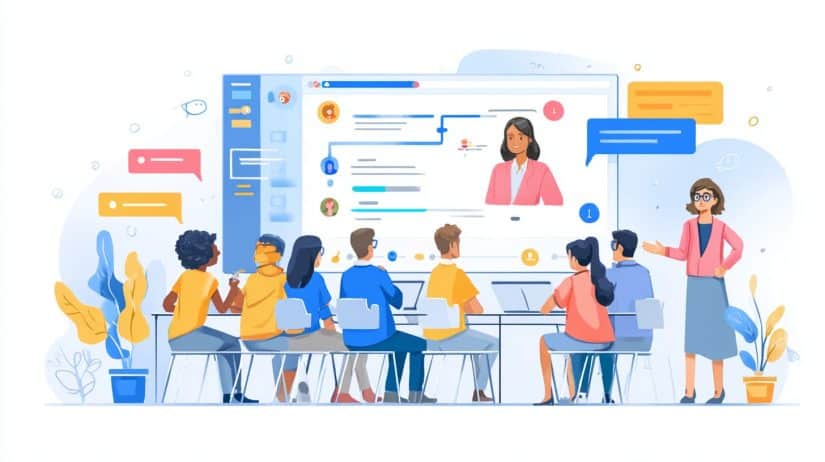
Learning industries are facing pressure. With classrooms, online courses, and training programs all evolving fast, there’s a nagging worry: could machines step in where humans once ruled?
For anyone working in creative web design, marketing, or course construction, this question matters. If the role of teachers or online creators shifts dramatically, so do the skills and services you offer. So, what’s real and what’s hype?
The Rise of AI in Education
Artificial intelligence (AI) is moving into education in big ways. From automated grading to personalised learning paths, the technology is becoming part of the fabric. As an example, a recent review concludes that AI can provide more personalised support in higher-education settings.
With that growth comes speculation: if AI can do more, could it eventually replace the human teacher or the creative course creator?
Emotional and Social Connection Matter
Human teachers bring more than facts. They build trust, respond to emotions, and adapt to a student’s mood or classroom atmosphere, something algorithms struggle to replicate. As one educator-oriented article puts it: “AI cannot replace the value of human expertise, creativity, and interaction in the teaching process.”
Adaptability and Complex Judgement
Learning isn’t just a set of tasks but is dynamic. Students ask unexpected questions, deviate from scripts, and bring in life contexts. AI struggles with these unpredictable aspects of teaching.
Teaching ≠ Just Content Delivery
For online course creators in particular, the role often includes creating engagement, moderating discussions, linking theory to practice, and iterating based on feedback. AI can assist with parts of that but the craft element remains heavily human.
How AI Will Change the Roles
Rather than full replacement, a more realistic pattern is transformation where roles evolve instead of vanish.
Teachers as Facilitators and Mentors
AI tools can free teachers from routine tasks. For instance, automating grading, generating test questions, or tracking student progress. That leaves more time for mentorship, discussion, and deeper feedback.
Course Creators Scaling and Streamlining
For online course makers, AI offers ways to boost efficiency: generating initial outlines, pulling in resources, creating quizzes at scale. But the creative spark, choosing the right examples, telling stories, weaving design & interaction, still needs a human.
An Augmented Workflow Table
| Role | What AI might take on | What humans still lead |
| Teacher | Automated feedback, data analytics, personalised exercises | Emotional support, class discussion, mentorship, and creativity in lesson design |
| Course Creator | Content-drafting, quiz generation, versioning, and scaling to many learners | Instructional design decisions, storytelling, brand voice, and community moderation |
The Implications for Web Design and Creative Agencies
Since your context is a creative web-design agency, thinking about how AI influences teachers and course creators has direct relevance.
Opportunity to Offer AI-Augmented Solutions
You might be designing websites, landing pages, or platforms for course creators. Recognising that many creators will use AI tools means your service could integrate those tools. For example, helping clients embed AI-powered quiz modules, chatbots for student help, or designs optimized for AI-generated content.
Shift in Target Skills
If teachers become more facilitators and less lecturers, their platforms (and your designs) will emphasize interactive, discussion-driven, community-based learning rather than static lectures. Embedding features like live sessions, peer forums, or social engagement will matter more.
Risks and Challenges to Watch
Over-reliance on Automation
If a course creator or teacher relies too heavily on AI for content generation, they may lose uniqueness, authenticity or fail to catch subtle errors and ethical issues.
Ethical and Quality Concerns
There are issues of bias, data privacy, and intellectual property when AI is involved in education. Design and creation need mindful governance.
The Human Connection Gap
The literature strongly emphasises that students’ emotional and relational experiences matter. Without that human element, engagement and deeper learning may suffer.
A Future of Partnership
The future for teachers and online course creators would be about reinvention. AI will handle more of the heavy lifting, the repetitive tasks, and the scale-generation. But the heart of education e.g. human connection, storytelling, mentoring, creativity, remains firmly human.
For those in creative web design and content creation for education, the shift opens up new services. Your clients will need platforms that facilitate human-led experiences supported by smart tools. The value will not lie in who creates content alone, but how it’s delivered, shaped, and connected to a learning community.